
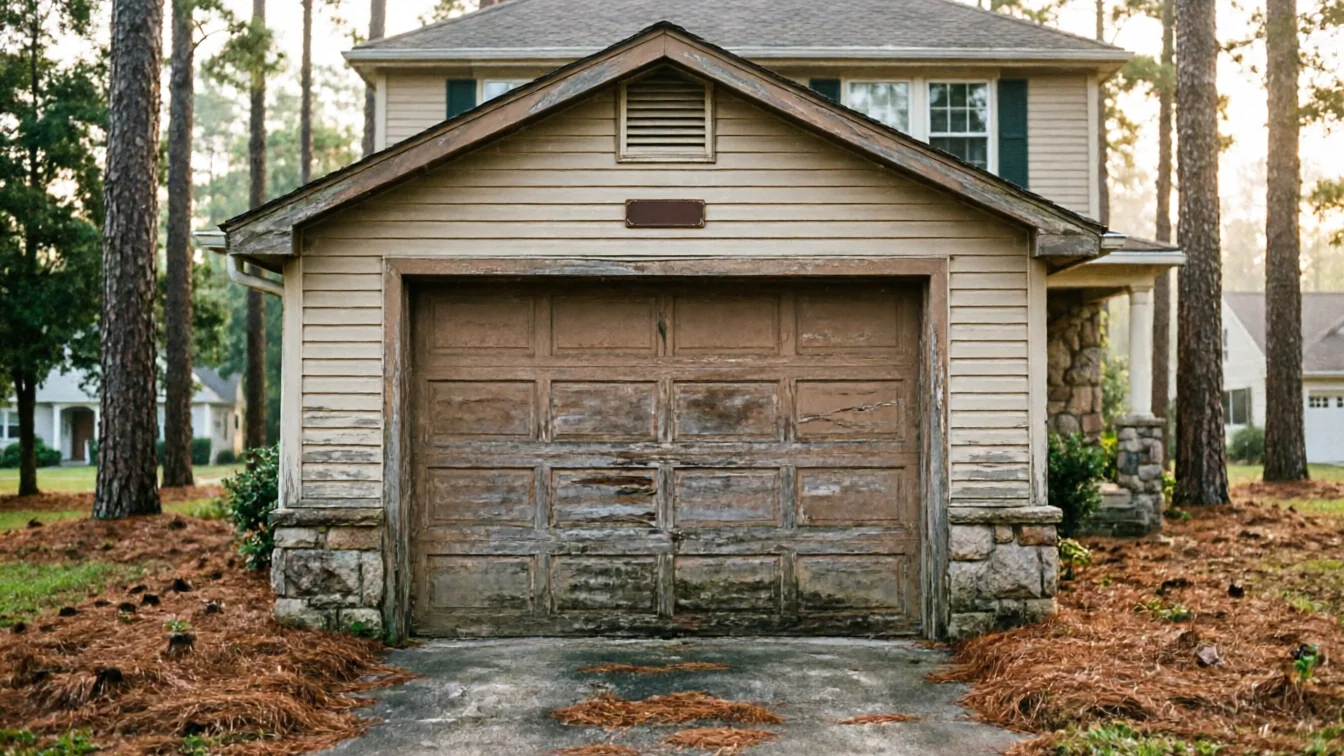
Dunwoody, GA · Garage Door Service
Deciding If Your Dunwoody Garage Door Still Has Life Left
Most Dunwoody homes date to the 1960s-70s building wave, with housing stock from 1951-2007. Here's how to tell if your door's original hardware is worth saving.
- Repairs & new doors
- Springs & openers
- Serving 7 nearby communities
What Local Conditions Do
Dunwoody's housing stock runs 1951 to 2007, with a median build year of 1978, and most of the neighborhoods here fall squarely into that 1960s-70s wave. That matters for a door more than people think. A door built when your house was built has had fifty-plus years of cold-season cycling behind it - not brutal cold by northern standards, but enough freeze-thaw swing in a moderate cold climate band to work moisture into wood panels and stiffen old lubricant inside torsion springs. Steel sectional doors from that era used thinner gauge metal and simpler roller hardware than what's sold today. None of that means the door is junk. It means the question isn't age alone - it's what fifty years of that specific cycling did to the specific parts. A door that's been serviced and kept dry ages differently than one that's been ignored in a low spot where water sits against the bottom panel. Local conditions set the clock. They don't decide the verdict by themselves.
The Situation
Across the area - Doraville, Chamblee, Ashford Park, North Brookhaven, and the other pockets within a few miles of Dunwoody - a huge share of garages are original to houses built in that same 1960s-70s stretch. With 56,735 owner-occupied houses across the wider service area and a median household income of $81,774, most owners here have the means to replace a door outright, but plenty still call asking for a repair first, and that's often the right instinct. The real situation is this: original hardware from that construction era was built to be repaired, not replaced. Torsion springs, hinges, and track brackets from the 1960s and 1970s are mechanically simple - simpler than a lot of current composite-panel doors with built-in sensors and lift assist. Simple means serviceable. A cracked panel or a sagging track on a door that age is often a parts swap, not a teardown. The trouble starts when the door's been patched more than once already, or when the opener and the door hardware are both original and both failing at the same time.
Where People Go Wrong
The mistake we see most is judging the door by its opener. The motor is the loudest, most visible part, so when it struggles, owners assume the whole unit is done. But in houses from the 1960s-70s wave, the motor is almost always newer than the door - openers get swapped out over the decades while the original steel panels and springs stay put. Replacing a working door because the opener is tired wastes money. The reverse mistake also happens: pouring money into spring and cable repairs on a door whose panels have already rusted through at the bottom from decades of ground moisture, which is a real risk for the lower-lying lots common in this area's older subdivisions. At that point you're fixing a door that was going to need replacing anyway in another year or two. The honest answer is we won't always know without seeing the door - rust at the seams, not just the surface, is usually the tell that panel damage has outrun what a patch job can fix.
What to Look At First
Start with the springs, not the panels. On a door built during Dunwoody's main construction wave, torsion springs are the part most likely to be original and most likely to be the actual problem - they lose tension gradually over fifty years of cold-season contraction and don't announce themselves until the door won't lift evenly. Next, check the bottom panel and the track brackets where they bolt to framing; that's where moisture does its slow work on older steel. If the panels are solid and the track is straight, a spring job or roller replacement is usually worth doing, cost-wise, on a door this age. If the bottom two feet of panel are soft or rusted through, or if the door's been realigned more than once, that's usually the point where a repair just buys you another year instead of solving anything. We won't push a fix on a door that's past it - some jobs aren't worth doing, and saying so up front is cheaper for everyone than a second service call.
Frequently asked questions
Is my garage door too old to repair if the house was built in the 1960s or 70s?
Not necessarily. Age alone isn't the issue - a lot of houses in this area have original doors from that construction wave, and the hardware from that era is mechanically simple enough to service. What matters more is whether the panels have rusted through at the bottom or the springs have been replaced before. We look at condition, not just the build year.
Should I replace the opener or the whole door?
These are usually separate decisions. In most Dunwoody houses from the 1960s-70s building wave, the opener has already been swapped at least once and is newer than the door itself. A struggling motor doesn't mean the original steel panels or springs need to go too.
What's the biggest sign a door isn't worth fixing anymore?
Rust that's gone through the bottom panel, not just surface rust. Decades of ground moisture against the lowest panel on older steel doors is the main thing that turns a repairable door into a replacement job, especially on lower-lying lots common in this area's older subdivisions.
Related garage door services in Dunwoody
More garage door guides
Book garage door service in Dunwoody
Call now or request a quote - tell us what the door is doing and where you are.